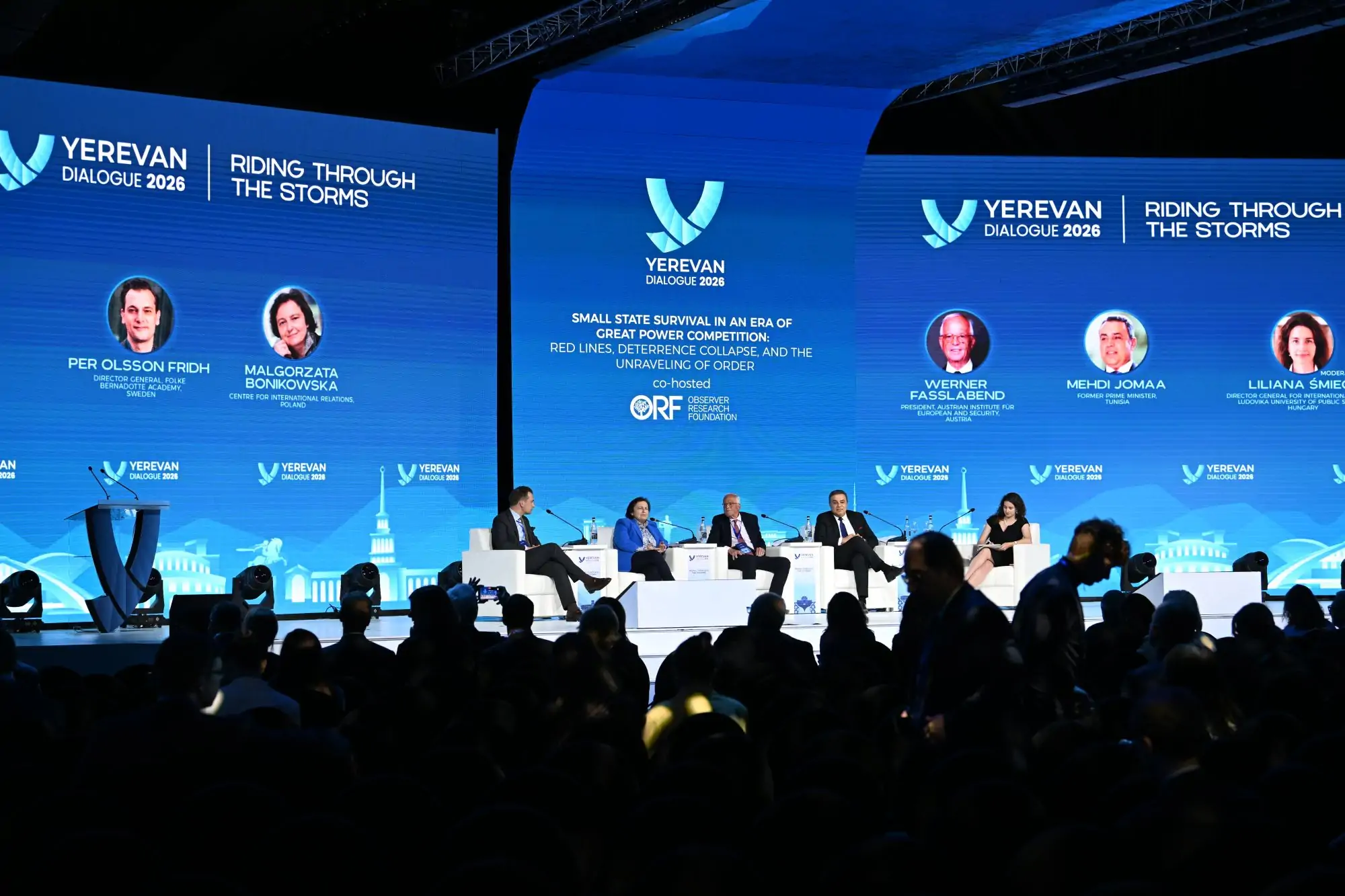
Small State Survival in an Era of Great Power Competition: Red Lines, Deterrence Collapse, and the Unraveling of Order (co-hosted by ORF)

The challenges facing small and medium-sized states in an increasingly fragmented international environment were at the center of the panel discussion “Small State Survival in an Era of Great Power Competition: Red Lines, Deterrence Collapse, and the Unraveling of Order,” held within the framework of the Yerevan Dialogue 2026 and co-hosted by the Observer Research Foundation.

The session was moderated by Liliana Śmiech, Director General for International Affairs of the Ludovika University of Public Service of Hungary, and featured Albin Kurti, Mehdi Jomaa, Former Prime Minister of Tunisia, Werner Fasslabend, President of the Austrian Institute für European and Security Policy of Austria, Malgorzata Bonikowska, Representative of the Centre for International Relations of Poland, and Per Olsson Fridh, Director General of the Folke Bernadotte Academy of Sweden.

Participants examined the gradual erosion of the rules-based international system and its implications for state sovereignty, particularly for smaller states that have traditionally relied on international law and multilateral institutions. The discussion explored whether effective deterrence mechanisms can be restored in an environment marked by declining institutional credibility and intensifying geopolitical competition.

Particular attention was devoted to the future viability of international law within an increasingly multipolar system, as well as to potential adaptive strategies available to smaller states, including regional cooperation, diversified partnerships, and technological innovation. Participants also discussed the consequences of weakening deterrence and the growing tendency to challenge established red lines in international relations.

The discussion underscored that the future of the international order will largely depend on balancing evolving power dynamics with normative frameworks, as well as on the ability of smaller states to navigate a global environment in which both legal norms and enforcement mechanisms face increasing pressure.

European Integration for the Prosecution Office: opportunities and challenges

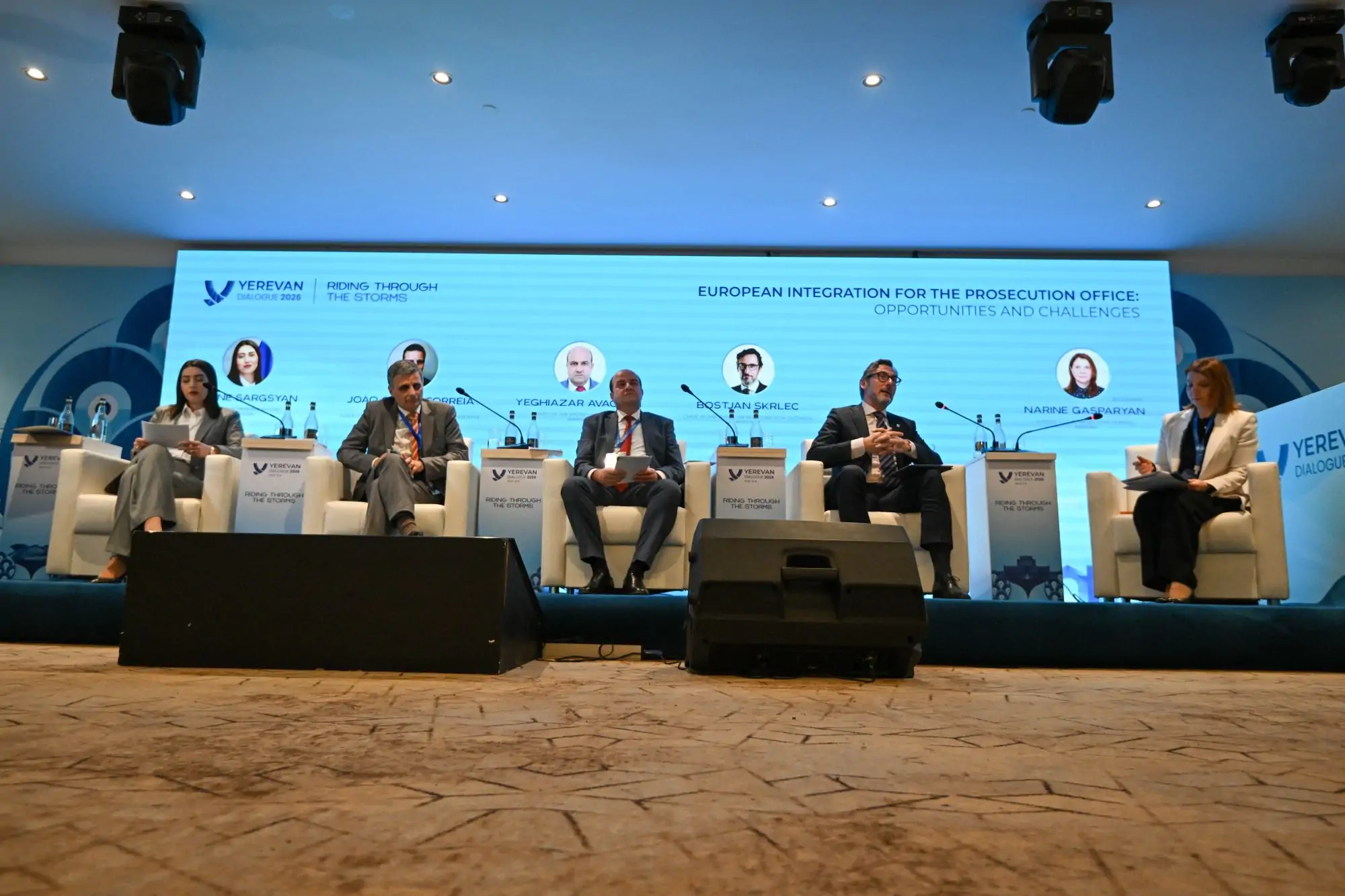
Strengthening prosecutorial cooperation and advancing alignment with European legal standards were at the center of the panel discussion “European Integration for the Prosecution Office: Opportunities and Challenges,” held within the framework of the Yerevan Dialogue 2026. The session brought together legal professionals and policymakers to examine the evolving role of prosecution services in the broader context of European integration.

The discussion was moderated by Narine Gasparyan, Adviser to the Prosecutor General of Armenia, and featured Bostjan Skrlec, Chair of the Board on Relations with Partners of EUROJUST, Anna Vardapetyan, Prosecutor General of Armenia, João Conde Correia, Senior Public Prosecutor of the Public Prosecutor’s Office and representative of the CARIN network of Portugal, and Arpine Sargsyan, Minister of Internal Affairs of Armenia.

Participants explored the importance of strengthening cooperation among prosecution services through the exchange of expertise and best practices with European partners. The discussion also focused on the institutional reforms and adjustments required to align national legal systems with European standards and improve responses to cross-border criminal activity.

Particular attention was devoted to practical cooperation mechanisms involving institutions such as EUROJUST, EUROPOL, the European Public Prosecutor’s Office, and the CARIN network. Participants discussed how these frameworks contribute to more effective international cooperation in combating organized and financial crime.

The discussion underscored that deeper integration with European legal and judicial mechanisms can significantly strengthen national prosecution systems by reinforcing the rule of law, improving institutional coordination, and enhancing responses to transnational criminal challenges.

Geoeconomics as the New Battlefield. Sanctions, Supply Chains, and Economic Statecraft in a Fragmenting World

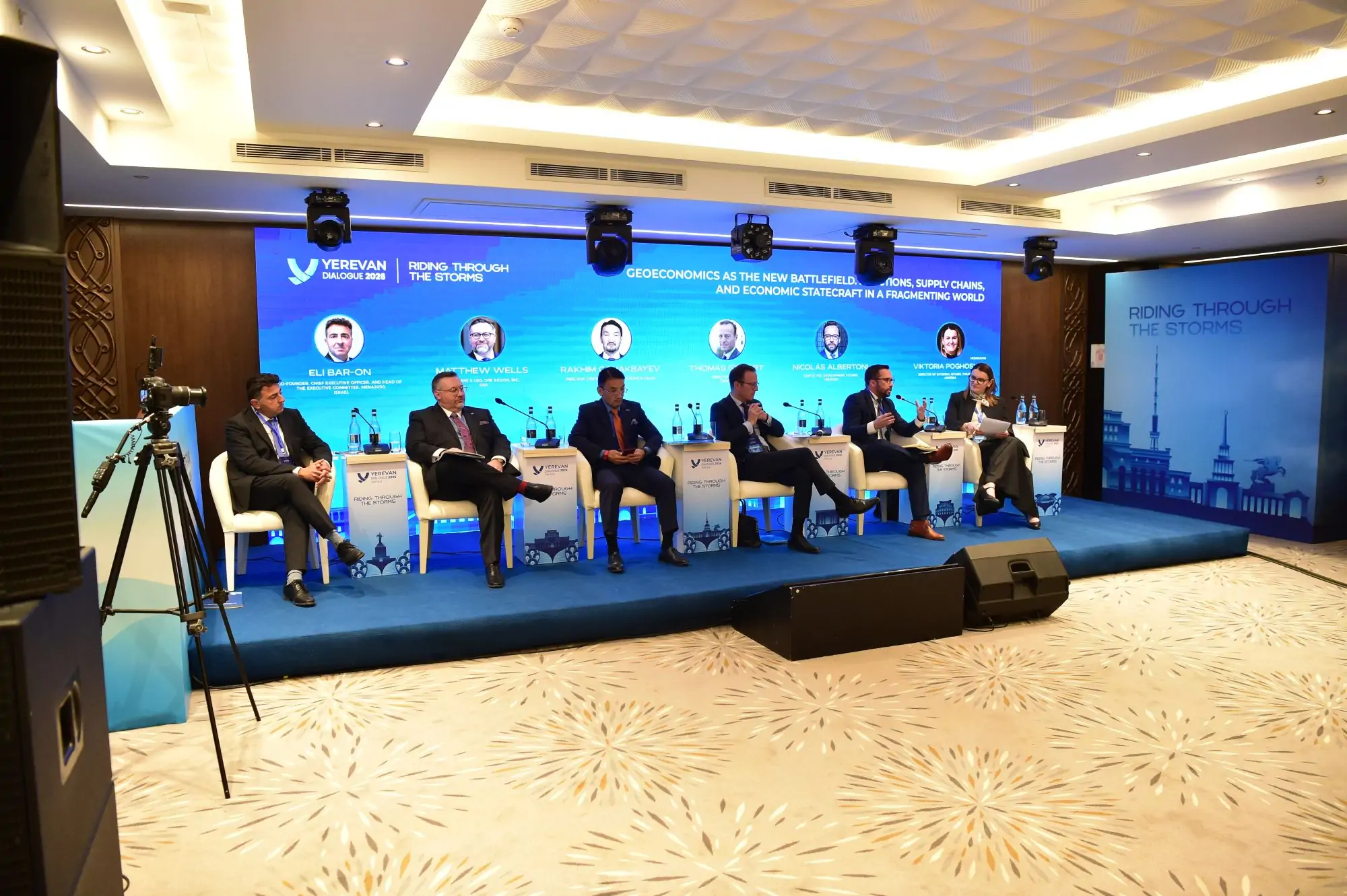
The increasing intersection between economics and geopolitics was the focus of the panel discussion “Geoeconomics as the New Battlefield: Sanctions, Supply Chains, and Economic Statecraft in a Fragmenting World,” held within the framework of the Yerevan Dialogue 2026. The session explored how economic instruments are increasingly shaping global competition and international power dynamics.

Moderated by Viktoria Poghosyan, Director of External Affairs of Philip Morris of Armenia, the panel featured Nicolás Albertoni, Representative of the Center for Development Studies of Uruguay, Thomas Gomart, Director of IFRI of France, Rakhim Oshakbayev, Director of the Center of Applied Research TALAP of Kazakhstan, Matthew Wells, President and CEO of One Region, Inc. of the United States, and Eli Bar-On, Co-founder, Chief Executive Officer, and Head of the Executive Committee of MENA2050 of Israel.

Participants discussed the growing use of sanctions, export controls, trade restrictions, and financial instruments as key tools of contemporary statecraft. The discussion examined how global competition is increasingly unfolding through supply chains, technological ecosystems, and financial infrastructure rather than through traditional military confrontation alone.

Particular attention was devoted to the implications of the weaponization of economic interdependence, including its impact on global trade systems, supply chain resilience, and international institutions such as the World Trade Organization. Participants also explored how economic connectivity can serve both as a stabilizing factor and as a source of strategic leverage in international relations.

The discussion underscored that geoeconomics is becoming an increasingly defining feature of contemporary international relations, requiring states to adapt to a global environment in which economic policy and geopolitical competition are more interconnected than ever before.

International Development Cooperation: Challenges and Prospects

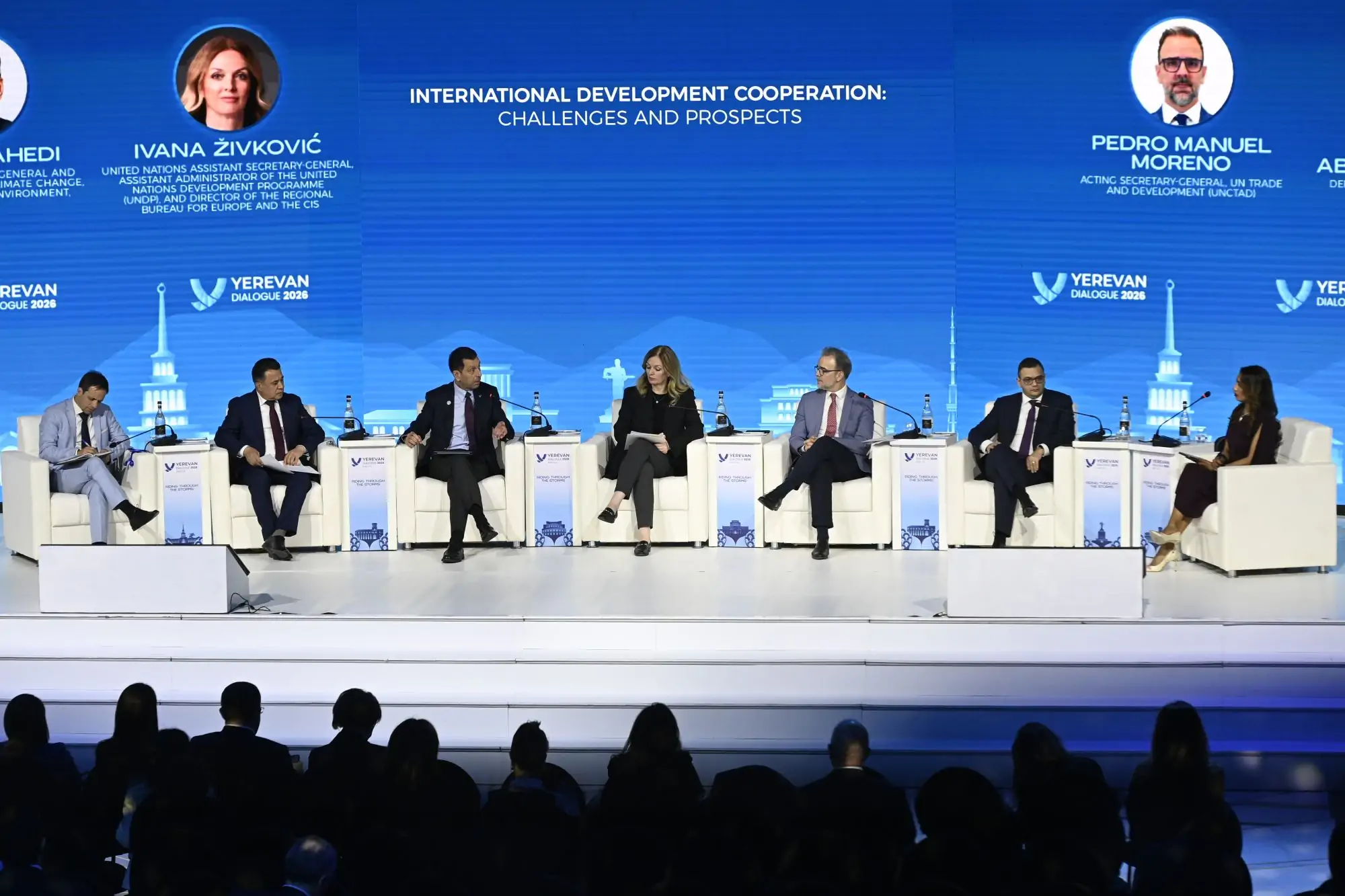
The future of international development cooperation amid growing geopolitical and socio-economic challenges was at the center of the panel discussion “International Development Cooperation: Challenges and Prospects,” held within the framework of the Yerevan Dialogue 2026. The session brought together high-level officials and experts to assess the changing dynamics of global development cooperation and the obstacles facing the implementation of the 2030 Agenda.

The discussion was moderated by Latika Bourke, Writer-at-Large of The Nightly, and featured Robert Abisoghomonyan, Deputy Minister of Foreign Affairs of Armenia, Pedro Manuel Moreno, Acting Secretary-General of UN Trade and Development, Ivana Živković, United Nations Assistant Secretary-General, Assistant Administrator of the United Nations Development Programme, and Director of the Regional Bureau for Europe and the CIS, Kaveh Zahedi, Assistant Director-General and Director of the Office of Climate Change, Biodiversity and Environment of the Food and Agriculture Organization, Khisrav Sohibzoda, Ambassador-at-Large and Special Envoy of the Ministry of Foreign Affairs of the Republic of Tajikistan, and David Fernandez Puyana, Ambassador and Permanent Observer of the University for Peace to the United Nations in Geneva and Vienna.

Participants examined the increasing pressures affecting international development cooperation, including armed conflicts, geopolitical fragmentation, environmental crises, and widening inequalities, all of which continue to hinder progress toward achieving the Sustainable Development Goals. The discussion also addressed ongoing efforts to reform the United Nations development system and adapt global financial mechanisms to emerging international challenges.

Particular attention was devoted to the need to revitalize international development cooperation through stronger multilateral frameworks, enhanced financing mechanisms, and closer coordination among international stakeholders. Participants also explored the implications of shifting global priorities, including the growing allocation of resources toward security-related expenditures.

The discussion underscored that achieving the Sustainable Development Goals will require renewed commitment to inclusive international cooperation, institutional reform, and practical policy solutions aimed at addressing the needs of the world’s most vulnerable countries and communities.

Defense Industrial Cooperation: Supply Chains, Talent, and the Role of Smaller States

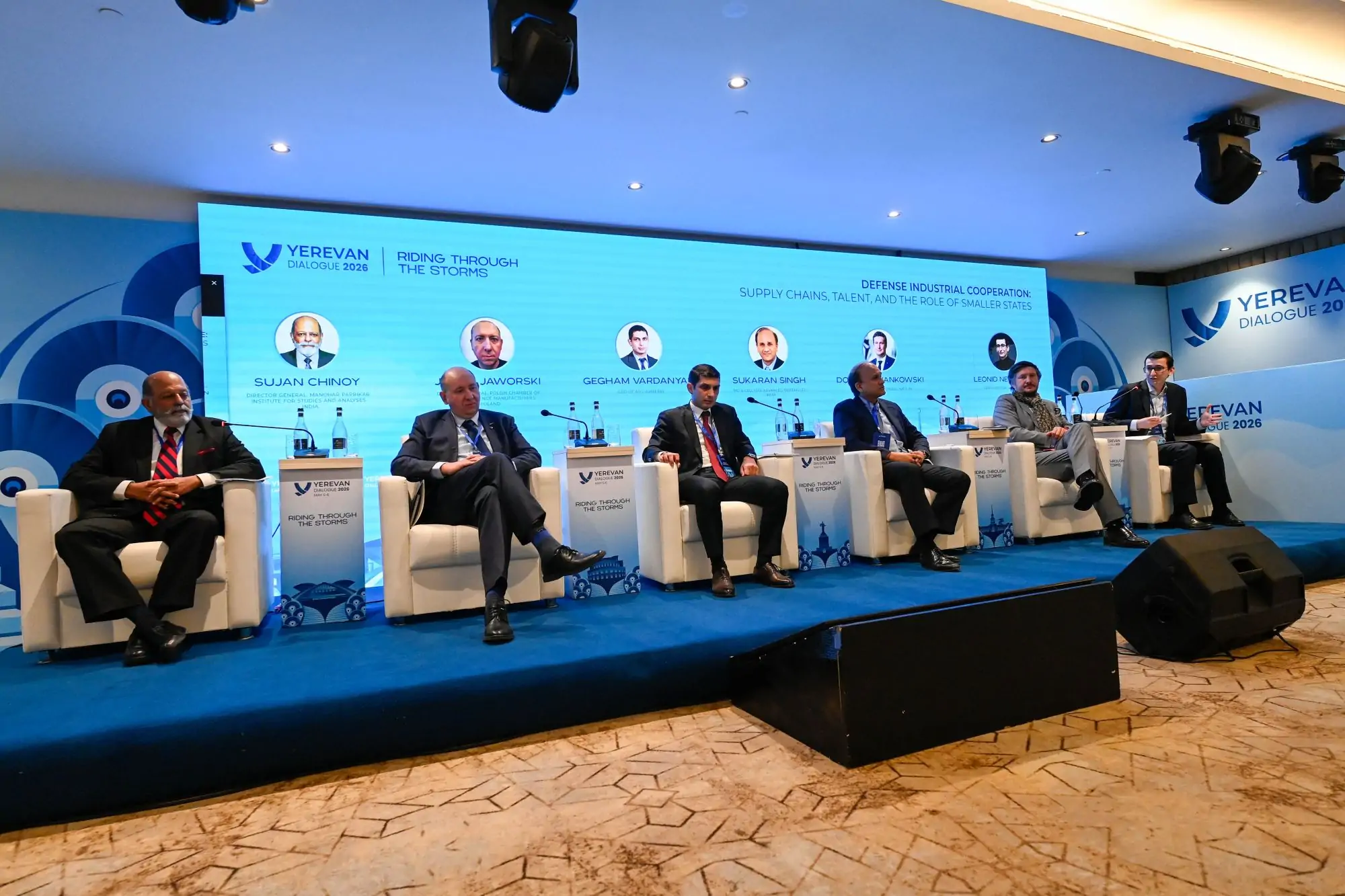
Emerging technologies, evolving supply chains, and the growing role of smaller states in the defense sector were the focus of the panel discussion “Defense Industrial Cooperation: Supply Chains, Talent, and the Role of Smaller States,” held within the framework of the Yerevan Dialogue 2026.

The panel was moderated by Leonid Nersisyan, Senior Advisor of APRI Armenia, and featured Dominik P. Jankowski, Deputy Secretary General of the NATO Parliamentary Assembly, Sukaran Singh, Managing Director and CEO of Tata Advanced Systems of India, Gegham Vardanyan, CEO of ATG of Armenia, Jakub Jaworski, Director General of the Polish Chamber of National Defence Manufacturers of Poland, and Sujan Chinoy, Director General of the Manohar Parrikar Institute for Defence Studies and Analyses of India.

Participants discussed how software-based systems, unmanned platforms, artificial intelligence, and commercial space capabilities are reshaping the defense industry and altering traditional models of defense production and innovation. The discussion highlighted that technological transformation is lowering conventional barriers to entry and enabling a broader range of countries to participate in defense innovation ecosystems.

Special attention was devoted to the growing importance of diversified supply chains and to the role smaller states can play through specialized expertise in software development, electronics, and advanced manufacturing. Participants explored how targeted investment in innovation and human capital can support the integration of these countries into global defense production networks.

The discussion emphasized that modern defense cooperation increasingly depends on strategic partnerships, flexibility, and the effective use of niche capabilities, contributing to more adaptive and resilient industrial and security frameworks.